Tuesday and Wednesday are statistically the slowest restaurant nights in the United States, with mid-week traffic running 35-50% below the Friday-Saturday peak. Owners deploying generic trivia on these nights see modest lift. Owners deploying the right themed trivia consistently triple the lift, sometimes turning a Tuesday into the second or third strongest revenue night of the week.
The difference is theme selection. Below: the four themes that move crowds, the demographics they pull, and how to price and promote each.
What makes a theme actually drive a crowd
Three factors separate themes that fill rooms from themes that don't.
Mass cultural saturation. The theme has to be something a high percentage of the target audience consumed without trying. Disney, Friends, 90s music, and Marvel pass this test. Cult-favorite shows with passionate but small audiences (Twin Peaks, Severance, etc.) do not. The math: a theme needs roughly 60%+ of your target demographic to have meaningful familiarity for it to fill a room.
Group-attendance friction. The theme has to work for groups of 4-6 friends, not just superfans. Friends trivia works because everyone in the group has watched at least some episodes. Specific season-by-season Mad Men trivia fails because only one person in the group cares.
Photographable enthusiasm. Themes that prompt themed outfits, themed drinks, or themed photos generate social content that fills next month's room. 80s music nights work because people will wear an 80s outfit. Generic history trivia doesn't work because nobody dresses up for it.
The four themes that consistently fill slow nights
Ranked by average crowd lift across venues that publish their numbers. All ranges below are net incremental covers vs. a normal Tuesday baseline at a 60-seat venue.
| Theme | Crowd lift vs. baseline | Demographic pull | Best night to run |
|---|---|---|---|
| Disney (adult) | +250-350% | 30-45, mostly female-leaning groups | Tuesday |
| Friends | +220-300% | 28-42, mixed groups, white-collar | Wednesday |
| 90s/2000s music decade | +180-260% | 32-48, broad mix, repeat-customer leaning | Tuesday or Thursday |
| Harry Potter / pop fantasy | +200-280% | 26-40, slightly more female, costume-friendly | Wednesday |
The lifts assume promoted, themed nights with the right décor cues, not a "themed" night that's basically your normal trivia with one bonus round. That distinction matters more than most owners realize.
Disney trivia: the highest-pulling slow-night theme
Adult Disney trivia consistently outdraws every other theme on the list. The audience is wider than expected because nostalgia for animated classics covers four decades and crosses gender lines among the 30-45 demographic.
Pricing match: $5-7 entry per player, $100-150 prize purse, full themed décor (Mickey ears at the door, themed cocktails like "Be Our Guest" sangria). The room expects effort because the theme demands it.
Promotion match: Instagram is the platform. Reels of staff in Disney costumes from the prep, posted 7-10 days out, plus a pinned story that drops 24 hours before the night. Email subject line that works: "Disney trivia is back. Bring your team and a Mickey ear headband."
Day-of-week match: Tuesday wins. The Disney audience skews to 30-45-year-old women in groups of 4-6 friends, and Tuesday fits their schedule without competing with weekend social plans.
Friends trivia: the white-collar workhorse
Friends trivia has had legs for two decades and shows no sign of slowing. The streaming-era kids who came up on the show in their teens are now in their late 20s and early 30s, sitting on top of the original mid-90s fan base who are now in their 40s. Two-generation pull, both group-friendly, both willing to spend on a Wednesday.
Pricing match: $5 entry, $100 prize, lighter décor than Disney (a Central Perk sign, the iconic font on signage, themed coffee drinks). The audience is sophisticated about the IP and will roll their eyes at heavy-handed décor.
Promotion match: a quote-based promotion. "How you doin'? See you Wednesday." or "Could we BE more excited?" plays well across Instagram, Facebook, and email. The audience is online and will share content that quotes the show.
Day-of-week match: Wednesday is the strongest night. The Friends audience plans more than the Disney audience, and Wednesday gives them a mid-week break without conflicting with weekend social calendars.
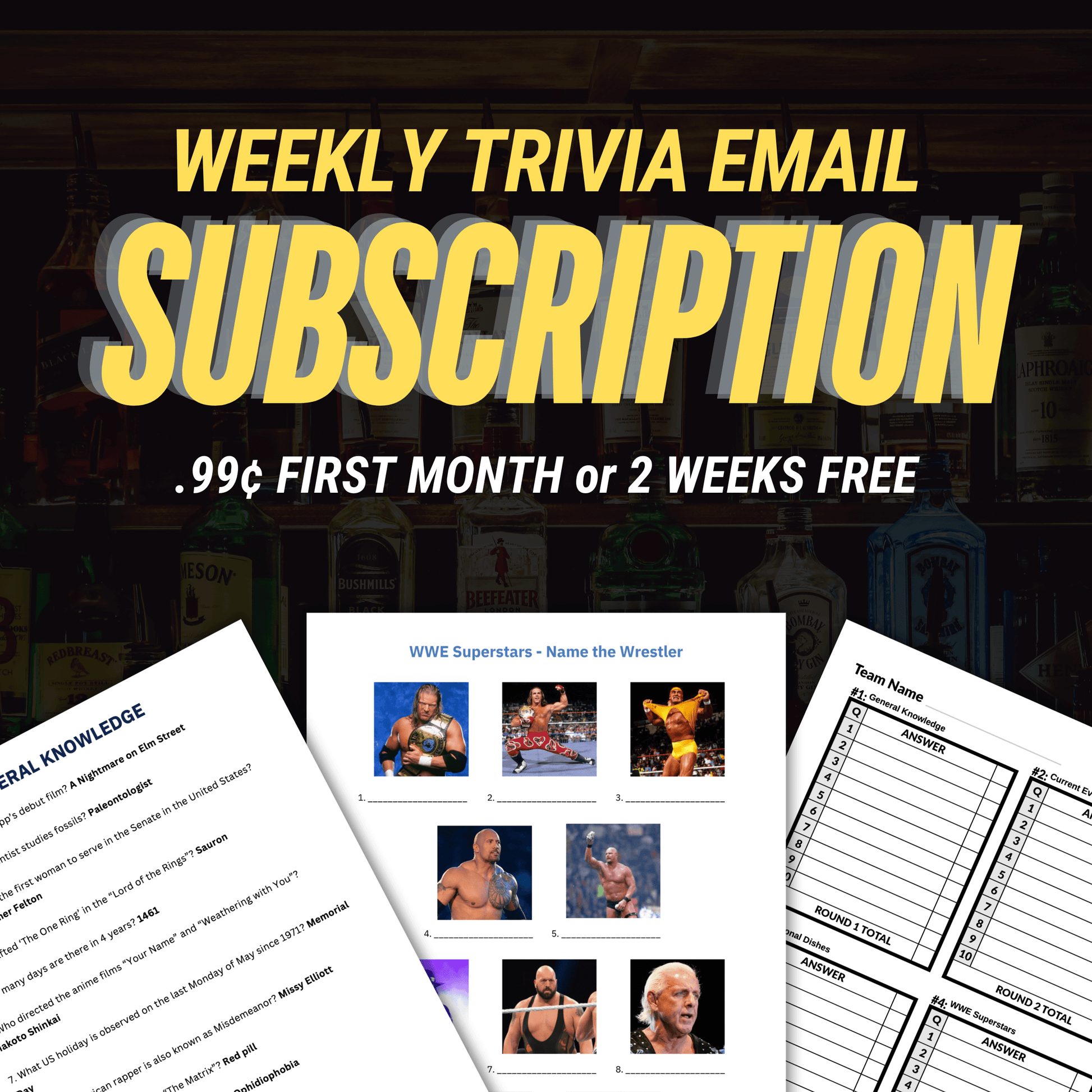
Weekly Trivia Subscription Service
A fresh trivia pack delivered every Monday. Four rounds, 40+ questions, picture round, host script. Covers the rotating themed nights you're running plus the standard general-knowledge fill-ins. Built for venues that want the calendar handled.
90s/2000s music decade nights: the broadest pull
Music decade trivia is the most flexible theme on the list because the format works for any age cohort the venue is trying to attract. Adjust the decade to the demographic: 90s for 35-45, 2000s for 30-40, 2010s for 25-32. Audio rounds carry the night, and the broader the music range within the decade, the wider the audience that can engage.
Pricing match: $5 entry, $75-100 prize, decade-themed cocktail menu. Boom box décor and TRL screen captures on the projector during breaks add atmosphere without requiring full costume commitment from guests.
Promotion match: nostalgia-driven. "The boy bands of your middle school" or "If you owned a TRL alarm clock, you're playing Tuesday." Email and Facebook outperform Instagram for this audience because the demographic skews slightly older and uses Facebook for event RSVPs.
Day-of-week match: Tuesday or Thursday work equally well. Avoid Wednesday because it overlaps with the Friends-trivia demographic and cannibalizes the same audience.
Harry Potter / pop fantasy: the costume-friendly category
Harry Potter trivia draws the most consistent costume engagement of any theme on the list. The audience expects to see at least some attendees in house scarves, robes, or themed accessories, which makes for sharper photos and a more visually distinctive night. The same playbook extends to Lord of the Rings, Star Wars, and Marvel for venues with a more genre-savvy audience.
Pricing match: $5 entry, $100 prize, plus a "best costume" $25 prize handed out at the start of round one. The costume prize is small but it sets the tone for the room.
Promotion match: house affiliation. "Sort yourself in: Gryffindor, Slytherin, Ravenclaw, or Hufflepuff. Wednesday at 7." Lets the audience self-identify before they even arrive, which compounds engagement.
Day-of-week match: Wednesday slightly beats Tuesday. The genre audience tends to be more committed planners than the music or sitcom audiences.
Themes to skip on a slow night (and why)
Plenty of themes look promising on paper and underperform in practice. The list below is shorthand for "save these for special events, not your weekly slow-night fill."
- Sports trivia (general). Drives a male-skewed crowd that's already at sports bars on the slow night. Doesn't pull new visitors. Exception: very specific sports moments (Olympic trivia, World Cup year, March Madness brackets).
- Current events / news trivia. Politically polarizing, hard to keep neutral, and the audience is small. Skip.
- Cult TV shows (Severance, Twin Peaks, Atlanta). Passionate fans, tiny audience. Fills 12 seats and disappoints them with low question depth.
- Generic "music trivia" without a decade or genre. Too broad to advertise, too vague to pull a crowd. Always specify.
- Local geography trivia (default). Unless paired with a specific moment (homecoming weekend, Drinksgiving), the local angle alone doesn't draw.
The rotating-theme calendar that maximizes slow-night revenue
One pattern that works across most venues: rotate themes monthly so the room always has a reason to come this week without burning out the audience on any single theme. A representative rotation:
- Week 1: Disney (Tuesday) — biggest pull, kicks the month off strong.
- Week 2: Friends (Wednesday) — different demographic, doesn't cannibalize week 1.
- Week 3: 90s music (Tuesday) — broader, repeat-customer-friendly.
- Week 4: Harry Potter or rotating wildcard (Wednesday) — closes the month with costume-friendly content.
This rotation produces a venue brand of "themed trivia weeks" rather than "Tuesday is trivia," which is a stronger pull. The promotion calendar leans on the theme of the week rather than the night of the week, which gives the marketing layer something to say each week instead of recycling the same generic message.
Net effect at a typical 60-seat venue: roughly $1,200-$2,000 in incremental Tuesday/Wednesday revenue per week versus a generic trivia program, scaling to $60,000-$100,000 per year.
The economics are not subtle. Picking the right theme isn't decoration; it's the difference between trivia paying for itself and trivia driving the most profitable mid-week stretch your venue runs.